



Directors Report to the 233rd National Advisory Mental Health Council
Welcome
I am pleased to welcome members of the National Advisory Mental Health Council (NAMHC), speakers and guests to our 233rd meeting. In this report I will share with you information about new and ongoing initiatives at the National Institutes of Health (NIH) and the National Institute of Mental Health (NIMH).
Response to Sandy Hook Tragedy
For the past 6 weeks, many at NIMH, the Substance Abuse and Mental Health Service Administration (SAMHSA), the Centers for Disease Control and Prevention (CDC) and elsewhere within the Department of Health and Human Services (DHHS) have been involved with the federal response to the tragic events in Newtown, Connecticut. This event, perhaps more than any other in the past decade, has focused the nation’s attention on gun violence, mental illness, and the sometimes difficult balance of ensuring personal freedoms while protecting public safety. On January 16, 2013, President Obama announced his Sandy Hook Response Plan , which described a commitment to addressing gun violence and the needs of those with mental illness. HHS Secretary Sebelius followed this announcement with a plan for adding 5,000 mental health care specialists; creating Project AWARE (Advancing Wellness and Resilience in Education) to increase understanding of mental health issues in schools with a reach to 750,000 students; and, launching a year-long national dialogue to discuss mental health and mental illness in communities across the nation. It is critical, in the wake of such a rare and horrific event, that we educate the public that most people treated for mental illness are not violent, and that most violence is not perpetrated by people with mental illness. NIMH will be working closely with SAMHSA and CDC to focus attention on the needs of those with mental illness, in a year that marks the 50th anniversary of President Kennedy’s campaign for reforming mental health care in America.
Budget
Fiscal Year (FY) 2012 Budget
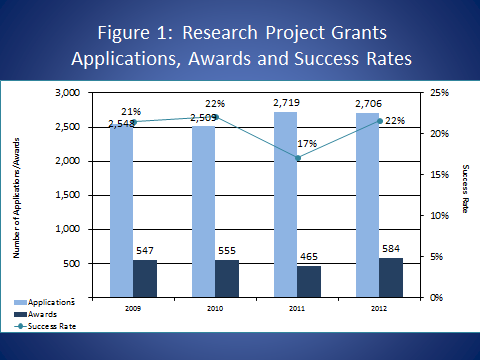
NIMH awarded 584 new and competing research project grants (RPGs) in FY 2012 and achieved an overall success rate of 22 percent (defined as number of RPG applications funded divided by the number of applications received; see Figure 1). This represents a significant increase over the 465 awarded in FY 2011 and consistent with the FY 2008-2010 average of 558. NIMH awarded grants to 115 new principal investigators and achieved a success rate of 25 percent for early stage investigators (ESIs).
FY 2013 Budget
Although FY 2013 began on October 1, 2012, there is still considerable uncertainty about the NIH and NIMH budgets. In order to continue in the absence of a formal FY 2013 budget appropriation, President Obama signed a continuing resolution (CR) on September 27, 2012. The CR continues government operations through March 27, 2013 at the FY 2012 level, plus 0.6 percent.
While operating under a CR, NIMH will issue non-competing research grant awards at a level below that indicated on the most recent Notices of Award (generally up to 90 percent of the previously committed level). As in previous CRs, we look forward to upward adjustments after the final appropriation is enacted later in the fiscal year and after NIH’s policy for funding non-competing commitments is finalized. We anticipate that competing research grant awards will be fully funded. Future year commitments on Non-Modular grants may be adjusted to reduce the out-year costs.
NIH-Wide Updates
NIH Common Fund Updates (co-led by NIMH)
The NIH Common Fund is a trans-NIH effort to support innovative science, stimulate interdisciplinary research, and reshape clinical research to accelerate medical discovery and improve public health. The following are projects co-led by NIMH:
The Genotype-Tissue Expression Project (NIMH Program Leads: Sue Koester, Ph.D., Roger Little, Ph.D.)
The Genotype-Tissue Expression (GTEx) project aims to provide a resource to the scientific community for the study of human gene expression and regulation and their relationship to genetic variation. In particular, the goal of this initiative is to understand how genetic variation may control gene expression across organs, tissues, and individuals. This project is collecting and analyzing multiple tissues from human donors who are also comprehensively genotyped, in order to assess genetic variation within their genomes.
GTEx has been approved to continue tissue collection and analysis to reach a goal of 900 donors. To date, over 220 post-mortem donors have entered the program, and collection of tissue from surgery donors is underway. Two Requests for Applications for new projects have been released to the research community: one (RFA-RM-12-019 ) for development of new analytical tools for these data; a second (RFA-RM-12-009 ) to support additional types of molecular assays on banked tissues from the same donors.
Molecular Libraries Program (NIMH Program Leads: Linda Brady, Ph.D., Ingrid Li, Ph.D.)
The Molecular Libraries and Imaging Program (MLP) has entered its fifth year. During the past five years, the MLP has discovered more than 260 new chemical probes on distinct targets that have been peer-reviewed and made available to biomedical researchers through the MLP Centers website (such as probes generated by Scripps, Vanderbilt, and NIH Chemical Genomics Center) and the NCBI Bookshelf , as well as commercial vendors such as Sigma-Adrich and Tocris Bioscience.
Receptos, Inc., announced on January 4, 2013 that one of its compounds, RPC1063, had been administered to the first patient in a Phase 2 clinical study examining the efficacy and safety of induction therapy in patients with moderately to severely active ulcerative colitis. Receptos successfully filed an Investigational New Drug (IND) Application with the Division of Gastroenterology and Inborn Errors Products (DGIEP) of the United States Food and Drug Administration (USFDA) in order to initiate the RPC01-202 study, known as TOUCHSTONE. Receptos also has an active IND for its compound RPC1063 with the Division of Neurology Products (DNP), through which it is currently conducting a Phase 2/3 study for RPC1063 in relapsing multiple sclerosis.
Health Economics (NIMH Program Leads: David Chambers, D.Phil., Agnes Rupp, Ph.D.)
NIH launched the Health Economics Program to address the evolving need for health economic research. The program goals include fostering the collection of data that will be most useful for health policy-relevant analysis; examining the economic effects of changes in incentives for consumers, providers and insurers; exploring the ways in which structure and organization on the supply side of the medical market affect health care spending and clinical outcomes; and, investigating the potential of preventive measures to improve health and mitigate cost growth. In November 2012, the Common Fund released two new requests for applications: Determinants and Consequences of Health care Personalization and Prevention (RFA-RM-12-023 ), and Diffusion of Medical Technology and Effects on Outcomes and Expenditures (RFA-RM-12-024 ). Letters of intent for both RFAs are due on January 28, 2013, with application due on February 28, 2013.
Health Care Systems Research Collaboratory (NIMH Program Lead: David Chambers, D.Phil.)
The overall goal of the Health Care Systems Research Collaboratory (HCSRC) program is to strengthen the national capacity to implement cost-effective large-scale research studies that engage health care delivery organizations as research partners. The aim of the program is to provide a framework of implementation methods and best practices that will enable the participation of many health care systems in clinical research, rather than support a defined health care research network. In September 2012, the HCSRC funded a Coordinating Center and seven pragmatic trial cooperative agreements (UH2/UH3), including one to Gregory Simon, Ph.D. and colleagues to test interventions to reduce risk of suicide among patients in integrated health care delivery systems.
Library of Integrated Network-based Cellular Signatures (LINCS) (NIMH Program Lead: Lois Winsky, Ph.D.)
The Library of Integrated Network-based Cellular Signatures (LINCS) project aims to establish a new understanding of health and disease through an integrative approach that identifies patterns of cellular signatures across different types of cells, reflecting multiple tissues, in response to a broad range of perturbations. LINCS Phase 1 began in October 2010 with large-scale data production, and, in 2011, additional subprojects developed algorithms for data analysis and integration, as well as novel molecular and cellular phenotypic assays.
A “LINCS Data Forum” will be held March 20-21, 2013 at Harvard Medical School in Boston, MA. This two-day workshop will feature presentations and posters relating to LINCS science, data resources, and software tools. Potential users of LINCS data from the broader scientific community are invited to attend.
Science of Behavior Change: Finding Mechanisms of Change in the Laboratory and the Field (NIMH Program Leads: Shelli Avenevoli, Ph.D., Bettina Osborn, Ph.D.)
Science of Behavior Change (SOBC) program seeks to promote basic research on the initiation, personalization, and maintenance of behavior change. A program announcement for administrative supplements (PA-12-119 ) was released in March, to examine behavioral interventions, with the goal of making them easier to implement. The announcement yielded 21 applications with four supplements awarded to NIMH grantees. A meeting of the SOBC program in October 2012 focused on frontiers in investigating change mechanisms across the stages of treatment development.
Metabolomics Initiative (NIMH Program Lead: Laurie Nadler, Ph.D.)
Metabolomics is the study of low molecular weight molecules or metabolites found within cells and biological systems. The metabolome is a measure of the output of biological pathways and, as such, is often considered more representative of the functional state of a cell than other ‘omics measures such as genomics or proteomics. In September 2012, the Program funded 16 new projects through five RFAs encompassing regional core facilities, technology development, and training in metabolomics.
NIH Blueprint for Neuroscience Initiatives
The Neuroscience Blueprint for Neuroscience is a framework to enhance cooperative activities among 16 NIH Institutes, Centers, and Offices that support research on the nervous system. The Blueprint aims to develop research tools, resources, and training and to make them available to the neuroscience community.
Grand Challenge on New Drugs for Diseases and Disorders of the Nervous System
The Grand Challenge on New Drugs for Diseases and Disorders of the Nervous System has set up a pipeline to move candidate drugs for nervous system disorders through preclinical development into early clinical trials. Successful applicants to the program receive funding to conduct biological testing in their laboratories and unprecedented access to a full range of industry-style drug development services and expertise. The investigators will retain the intellectual property for compounds they develop through this program. In the most recent round of applications, two new applications are funded in the areas of narcolepsy and Parkinson’s Disease.
NIH Neurobiobank
The NIH Neurobiobank is an initiative supported by NIMH, the Eunice Kennedy Shriver National Institute of Child Health and Human Development, and the National Institute of Neurological Disorders and Stroke. The goal of the Neurobiobank initiative is to provide human tissues to researchers to enable identification of pathology and genetics underlying brain disorders. The effort consists of shifting NIH support of brain banks from grants to contracts, establishing a web-based IT system to federate the brain banks, and a public outreach effort. The Neurobiobank IT Portal contract was issued to IMS of Rockville, MD in October 2012. The Portal will link NIH-supported brain banks across the country as the primary point of entry on the internet for researchers applying for tissues, as well as for brain bank investigators to track, process, and approve requests in a transparent manner. A web interface designed for the public will explain and educate about the importance of brain and tissue donation for research, and provide contact information of for people to call for more information or to prospectively consent.
The NIH Neurobiobank workgroup hopes to have this online in a beta-testing mode by April 2013.
National Database for Autism Research
The National Database for Autism Research now provides access to clinical assessments, demographic information, environmental information, imaging studies and genetic/sequencing data from more than 40,000 subjects for researchers. An upgrade to the website in December 2012 provided significantly enhanced search capability, including access to significant imaging and -omics data that complement the already significant demographic and clinical assessment data. Vast summary data are available on the website.
NIMH Updates
Outreach Partnership Program (OPP)
Two new Outreach Partners for the state of California have been selected following NIMH’s solicitation and review process, completed in October 2012. The Mental Health Association of California will represent the Northern and Central regions of the state, while Mental Health America of Los Angeles in partnership with the Southern California Clinical and Translational Science Institute will represent the Southern region. Benefits of the program include a $7,500 award, access to bulk NIMH publications free of charge, networking opportunities with other state and national organizations, and sponsored participation in OPP’s annual meeting.
Grantee Awards
- Ralph Adolphs, Ph.D., Professor of Psychology and Neuroscience at the California Institute of Technology received the Social and Affective Neuroscience Society (SAN) Distinguished Scholar Award on October 12, 2012. The SAN Distinguished Scholar Award recognizes the broad scope and potentially integrative nature of scholarship in social and affective neuroscience, honoring a scientist who has made distinctively valuable research contributions across his or her career by significantly advancing our understanding of the biological basis of social and affective processes or expanding the core of social and affective neuroscience discipline.
- Huda Akil Ph.D. and Stanley Watson Ph.D. received the 2012 Institute of Medicine’s Rhoda and Bernard Sarnat International Prize for research on mental health and addiction. Drs. Akil and Watson, who co-direct the Molecular and Behavioral Neuroscience Institute at the University of Michigan, Ann Arbor, were recognized for their individual and collaborative efforts to elucidate the neural underpinnings of emotions, mental illnesses, and substance abuse.
- Schahram Akbarian M.D. received the American College of Neuropsychopharmacology (ACNP) Eva King Killam Award recognizing outstanding translational research contributions to neuropsychopharmacology. Dr. Akbarian’s research on epigenetics and schizophrenia has opened a new area for defining the neurobiology of psychosis.
- Several Investigators supported by NIMH were among the 70 new members elected to the Institute of Medicine (IOM) of the National Academies. Election to the IOM is considered one of the highest honors in the fields of health and medicine. Below are the newly elected members with ties to NIMH and their affiliated organizations:
- Norman B. Anderson, Ph.D., CEO and Executive Vice President, American Psychological Association, Washington, D.C.
- Myron S. Cohen, M.D., J. Herbert Bate Distinguished Professor of Medicine, Microbiology, and Immunology, and Associate Vice Chancellor for Global Health, University of North Carolina, Chapel Hill
- Robert H. Edwards, M.D., Professor, Departments of Neurology and Physiology, University of California, San Francisco
- Sandro Galea, M.D., Dr.P.H., Anna Cheskis Gelman and Murray Charles Gelman Professor and Chair, Department of Epidemiology, Mailman School of Public Health, Columbia University, New York
- Jens Ludwig, Ph.D., McCormick Foundation Professor of Social Service Administration, Law, and Public Policy, Harris School of Public Policy, and director, University of Chicago Crime Lab, University of Chicago, Chicago
- Marina Picciotto, Ph.D., Charles B. G. Murphy Professor of Psychiatry and Professor of Neurobiology and Pharmacology, Department of Psychiatry, Yale University School of Medicine, New Haven
- Stephen R. Quake, D.Phil., Investigator, Howard Hughes Medical Institute; and Lee Otterson Professor of Bioengineering and Applied Physics, Department of Applied Physics, Stanford University, Stanford
- Steven A. Siegelbaum, Ph.D., Investigator, Howard Hughes Medical Institute; and Professor of Neuroscience and Pharmacology and Chair, Department of Neuroscience, Columbia University Medical Center, New York
- Sten H. Vermund, M.D., Ph.D., Professor of Pediatrics, Medicine, Preventive Medicine, and Obstetrics and Gynecology, Department of Pediatrics, and Amos Christie Chair of Global Health and Director, Institute for Global Health, Vanderbilt University School of Medicine, Nashville
- Charles F. Zorumski, M.D., Samuel B. Guze Professor of Psychiatry, Professor of Neurobiology, and Head, Department of Psychiatry, Washington University School of Medicine, St. Louis
- Alan Antisevic, Ph.D., an Associate Research Scientist in the Department of Psychiatry at Yale University, was awarded a 2012 NIH Director’s Early Independence Award for the project, “Characterizing Cognitive Impairment in Schizophrenia via Computational Modeling and Pharmacological Neuroimaging.”
- Larry K. Brown, M.D. received the Charlotte and Norbert Rieger Award for Scientific Achievement from the American Academy of Child and Adolescent Psychiatry (AACAP) at the October 25, 2012 Annual Meeting in San Francisco where he presented his paper, “Safe Thinking and Affect Regulation (STAR): Human Immunodeficiency Virus Prevention in Alternative/Therapeutic Schools.”
- Bethany Brookshire, Ph.D. from the University of Pennsylvania was awarded the Society for Neuroscience (SfN) postdoctoral Next Generation Award. This award recognizes SfN chapter members who have made outstanding contributions to public communication, outreach and education about neuroscience.
- Karl Deisseroth, M.D., Ph.D., D.H. Chen Professor of Bioengineering and of Psychiatry and Behavioral Sciences at Stanford University, is the recipient of the Richard Lounsbery Award. Dr. Deisseroth is honored for pioneering the technology called optogenetics in which insertion of a single bacterial protein into a neuron allows exquisite control of the neuron with light. Dr. Deisseroth’s technology enables precise control of neural activity at the millisecond timescale in awake and freely-moving animals. His approach has been adopted by thousands of scientists around the world.
- Robert D. Gibbons, Ph.D., Professor of Medicine and Health Studies, and Director of the Center for Health Statistics at the University of Chicago, received the 2012 American Public Health Association’s (APHA) Rema Lapouse Award in San Francisco, California on October 29, 2012. The Rema Lapouse Award is granted annually to a researcher for excellence in Psychiatric Epidemiology. At the APHA meeting, Professor Gibbons presented the Rema Lapouse Lecture entitled the Future of Mental Health Measurement that has recently been published in Archives of General Psychiatry.
- Xue Han, Ph.D., Assistant Professor of Biomedical Engineering, Boston University received an NIH Director’s New Innovator Award for her study “Light-Actuatable NanoRobots for Molecular Uncaging.” Announced on September 13, 2012, these awards support exceptionally creative and innovative early career researchers with the potential to transform their field and advance improved health outcomes.
- Brian K. Kobilka, M.D., Professor of Medicine, Cardiology, and Molecular and Cellular Physiology at Stanford University School of Medicine, won the2012 Nobel Prize in Chemistry . He shares the award with Robert J. Lefkowitz, M.D. of Duke University for explaining the communication system that the human body uses to send messages to cells. The two researchers studied a family of receptors on cells—G protein coupled receptors (GPCRs)—that are critical for the normal function of the brain and heart among many other organs.
- Dayu Lin, Ph.D. received the Trubatch Career Development award from the SfN. Her research at New York University Langone Medical Center focuses on the neurobiology of fear and aggression, probing how circuits underlying aggression change with genetic manipulation using optogenetics and electrophysiology techniques.
- Anil Malhotra, M.D. and Rita Goldstein, M.D. received the ACNP Joel Elkes Award for outstanding clinical contributions to neuropharmacology by a young investigator.
- Alice Medalia, Ph.D., Professor of Clinical Psychiatry and Director of Psychiatric Rehabilitation at Columbia University Medical Center, was awarded the 2012 Productive Lives Award by the Brain and Behavior Research Foundation in October 2012. The Brain and Behavior Research Foundation (which awards National Alliance for Research on Schizophrenia and Depression (NARSAD)Grants) bestows the Productive Lives Award to individuals who devote their expertise, talents, and energy to helping individuals with mental illness.
- Bernice A. Pescosolido, Ph.D., Distinguished Professor of Sociology in the Department of Sociology in the College of Arts and Sciences, Indiana University and Director of the Indiana Consortium for Mental Health Services Research, was awarded the 2012 Carl Taube Award given by the Mental Health Section of the APHA in San Francisco, in October 2012 during the annual meeting. The Carl Taube Award honors those who have made significant contributions to the field of mental health services research. Dr. Pescosolido delivered the Carl Taube Award Lecture, entitled “Stigma of Mental Illness: An Overview of Research Findings and the New Directions They Demand.”
- Russell Poldrack, Ph.D., Professor of Psychology and Neurobiology, University of Texas at Austin, Tal Yarkoni, Ph.D., Research Associate at the Institute of Cognitive Science, University of Colorado at Boulder and David Van Essen, Ph.D., Professor of Anatomy and Neurobiology, Washington University in St. Louis were recipients of the SAN Society 2012 Innovation Award for their publication Large-scale automated synthesis of human functional neuroimaging data , Nature Methods 8:665-670 (2011). These awards recognize a publication likely to generate the discovery of new hypotheses, new phenomena or new ways of thinking about the discipline of social and affective neuroscience.
- Solomon H. Snyder, M.D., D.Sc., D.Phil, Professor of Neuroscience, Pharmacology, and Psychiatry at the Johns Hopkins University School of Medicine, is the recipient of the NAS Award in the Neurosciences. Dr. Snyder is being recognized for his groundbreaking work on opiate receptors, gaseous signaling in the nervous system, and numerous other contributions to our understanding of neuropharmacological processes. The award is presented every three years and recognizes excellence in neuroscience research.
- Richard Tsien, D.Phil. of New York University Langone Medical Center was awarded the Julius Axelrod Prize at the SfN Annual Meeting held October 13-17, 2012 in New Orleans, in recognition of his contributions to what neuroscientists currently understand about cellular signaling, as well as his role in mentoring young scientists for more than 40 years. Dr. Tsien’s insights into the basic mechanisms of ion channel function, neurotransmitter release and intracellular signaling have helped define modern neuropharmacology.
- Vanderbilt University’s Neuroscience Graduate Program was recognized by the SfN with its inaugural Neuroscience Graduate Program of the Year Award. Founded in 1999, the interdisciplinary graduate program is administered through the Vanderbilt Brain Institute, currently under the direction of Mark Wallace Ph.D. Dr. Wallace is an NIMH awardee and is director of the Jointly Sponsored Predoctoral T32 Program in the Neurosciences award which supports early-stage graduate training at Vanderbilt University.
- Larry J. Young, Ph.D. received the 2012 ACNP Daniel H. Efron Award for outstanding achievement in the basic science of neuropharmacology. Dr. Young’s work on oxytocin and vasopressin in prairie voles has provided a powerful model for studying the molecular basis of social attachment.
NIMH Awards and Honors
- Myra Brockett, Jane Steinberg, Ph.D., and Tracy Waldeck, Ph.D. of the Division of Extramural Activities (DEA), received the Office of the Director Honor Award, for their extraordinary dedication and teamwork in the rapid development of FY 2012 Funding Opportunity Announcements related to Bioethics.
- Vinod Charles, Ph.D., a Scientific Review Officer in DEA, received the Office of the Director Honor Award for his contributions to the Review Policy Committee Scientific Review Officer (SRO) Technical Competencies Team in recognition of exceptional vision, teamwork and collaboration in identifying SRO core technical competencies.
- Kathleen O’Leary, M.S.W. was among the members of the NIH group that received the 2012 NIH Director’s Award for launching and participating in the first NIH Lesbian, Gay, Bisexual and Transgender Research Coordinating Committee. The Committee completed a portfolio analysis and report on NIH research in this area to identify research gaps and opportunities in response to the Institute of Medicine’s 2011 report recommendations to NIH.
- Maryland Pao, M.D., Chief of the Psychiatry Consultation Liaison Service in the Mark O. Hatfield Clinical Research Center and Clinical Director of the NIMH Intramural Research Programs (IRP) was recipient of the 2012 Simon Wile Leadership in Consultation Award. This award acknowledges outstanding leadership and continuous contributions in the field of consultation-liaison child and adolescent psychiatry.
NIMH Staff News
Arrivals/Moves
- Anjene Addington, Ph.D. joined the Genomics Research Branch of DNBBS in the fall of 2012. Dr. Addington has extensive experience in psychiatric genetics, having served as a staff scientist and Director of Genetics Studies in the Child Psychiatry Branch of the IRP from 2002-2010. Just prior to her appointment in DNBBS she was a Lead Associate for Booz Allen Hamilton.
- Stefano Bertuzzi, M.P.H., Ph.D., who served as Director of the Office of Science Policy, Planning, and Communications (OSPPC) from November 2011 to November 2012, accepted the position of Executive Director at the American Society for Cell Biology. Prior to coming to NIMH, Dr. Bertuzzi worked in the Office of Science Policy as the Director for the Return on Investments program.
- Vicki Buckley, who served as the Associate Director for Intramural Administration of the Office of Intramural Research Administration (OIRA), IRP, will be leaving on January 25, 2013. She will be the Deputy Executive Officer of the National Eye Institute.
- Jay Churchill, Ph.D. has moved into the role of Principal Program Official for the Army Study to Assess Risk and Resilience among Service-members (Army STARRS) as of December 1, 2012. Dr. Churchill served as Training Director in the Division of Developmental Translational Research and continues to consult with the Division regarding training.
- Kathleen O’Leary, M.S.W. was appointed Chief of the Women’s Program in the Office of Research on Disparities and Global Mental Health in December 2012. She served as Deputy Chief of the Women’s Program at NIMH beginning in 2005 and took on the role as Acting Chief in February 2007. Ms. O’Leary leads the trans-divisional NIMH Women’s Team and also works closely with the NIH Office of Research on Women’s Health and the HHS Office on Women’s Health for initiatives that include prenatal mental health, sex differences research, mental health issues of women serving in the military and the mental health effects of violence against women. Ms. O’Leary has worked for NIMH for over 30 years: she supervised the Patient Screening and Human Subjects Protection Team and later supervised clinicians working with schizophrenia spectrum disorder patients; she was also a coordinator for the study of borderline personality disorder and worked as a research clinician studying adolescent mothers and their infants.
- Kevin Quinn, Ph.D. has taken over as Director of OSPPC, effective December 1, 2012. Dr. Quinn was the Chief of the Behavioral Science and Integrative Neuroscience Research Branch in the Division of Neuroscience and Basic Behavioral Science and served as the principal Program Officer for the Army STARRS project. He will continue to serve on Army STARRS as Study Director.
- Varda Shoham, Ph.D. joined NIMH in December 2012 as Special Advisor for Translational Research within the Division of Adult Translational Research and Treatment Development. She came to the Institute in the fall of 2010 on sabbatical from the University of Arizona where she was Professor of Psychology. Dr. Shoham’s research focuses on how and for whom psychosocial treatments work, testing hypotheses derived from basic psychological theories of problem maintenance and change.
- Michael Vogel, Ph.D., a Program Officer in the Office of Research Training and Career Development within the Division of Neuroscience and Basic Behavioral Science has accepted a position in the Office of Initiative Development at the National Institute of Allergy and Infectious Diseases, effective January 27, 2013.
- Dave Zielinski, Ph.D. has accepted the position of Chief of the Science Policy and Planning Branch at NIAMS. Dr. Zielinski joined OSPPC as a Health Science Policy Analyst in 2006 where he led many of the reporting activities to NIH, HHS, Congress and the White House.
Retirements
- Joan Cole retired after more than 30 years of Federal service. In 1991 she rejoined NIMH as an editor in the Division of Clinical Research, and then joined DEA as a program analyst in 1998. In 2002, she moved to what is now OSPPC, where she coordinated many trans-NIMH data collection efforts for reports to NIH, HHS, Congress and the White House.
- Linda Hoffman has retired after 27 years of government service, having spent the past 14 years in OSPPC. Ms. Hoffman served as the lead NIMH Controlled Correspondence Coordinator overseeing all Executive Secretariat activities.
- Joel Kleinman, M.D., Ph.D. retired as Chief and Senior Investigator of the Section on Neuropathology of the Clinical Brain Disorders Branch, IRP.
- Marsha Love retired from NIMH in fall 2012, capping a career that included decades of public service. Ms. Love served as Lead Public Affairs Specialist for the past four years. Her work at the Institute included serving as lead editor for NIMH publications.
- Emeline Otey, Ph.D. retired after 32 years of government service. Her tenure with NIMH included numerous roles including Scientific Review Officer and Program Officer in several NIMH divisions. She retired as a Program Chief within DSIR focusing on training and career development programs.
Deaths
- Patrick Bender, Ph.D. passed away on October 3, 2012 after suffering a heart attack. He joined NIMH as a contractual employee in 2009 and became a Program Officer in the Office of Genomics Research Coordination in December 2010. Having been involved in many cross-NIMH and trans-NIH activities, Dr. Bender was to receive the NIMH Director’s Award on October 10, 2012 in recognition of his myriad scientific contributions and accomplishments.