Woman with arm around girl who is crying

Answers to students’ frequently asked questions about depression.


Depression can occur during adolescence, a time of great personal change. You may be facing changes in where you go to school, your friends, your after-school activities, as well as in relationships with your family members. You may have different feelings about the type of person you want to be, your future plans, and may be making decisions for the first time in your life.

Many students don’t know where to go for mental health treatment or believe that treatment won’t help. Others don’t get help because they think depression symptoms are just part of the typical stresses of school or being a teen. Some students worry what other people will think if they seek mental health care.

This fact sheet addresses common questions about depression and how it can affect high school students.

Q. What is depression?

A. Depression is a common but serious mental illness typically marked by sad or anxious feelings. Most students occasionally feel sad or anxious, but these emotions usually pass quickly—within a couple of days. Untreated depression lasts for a long time and interferes with your day-to-day activities.

Q. What are the symptoms of depression?

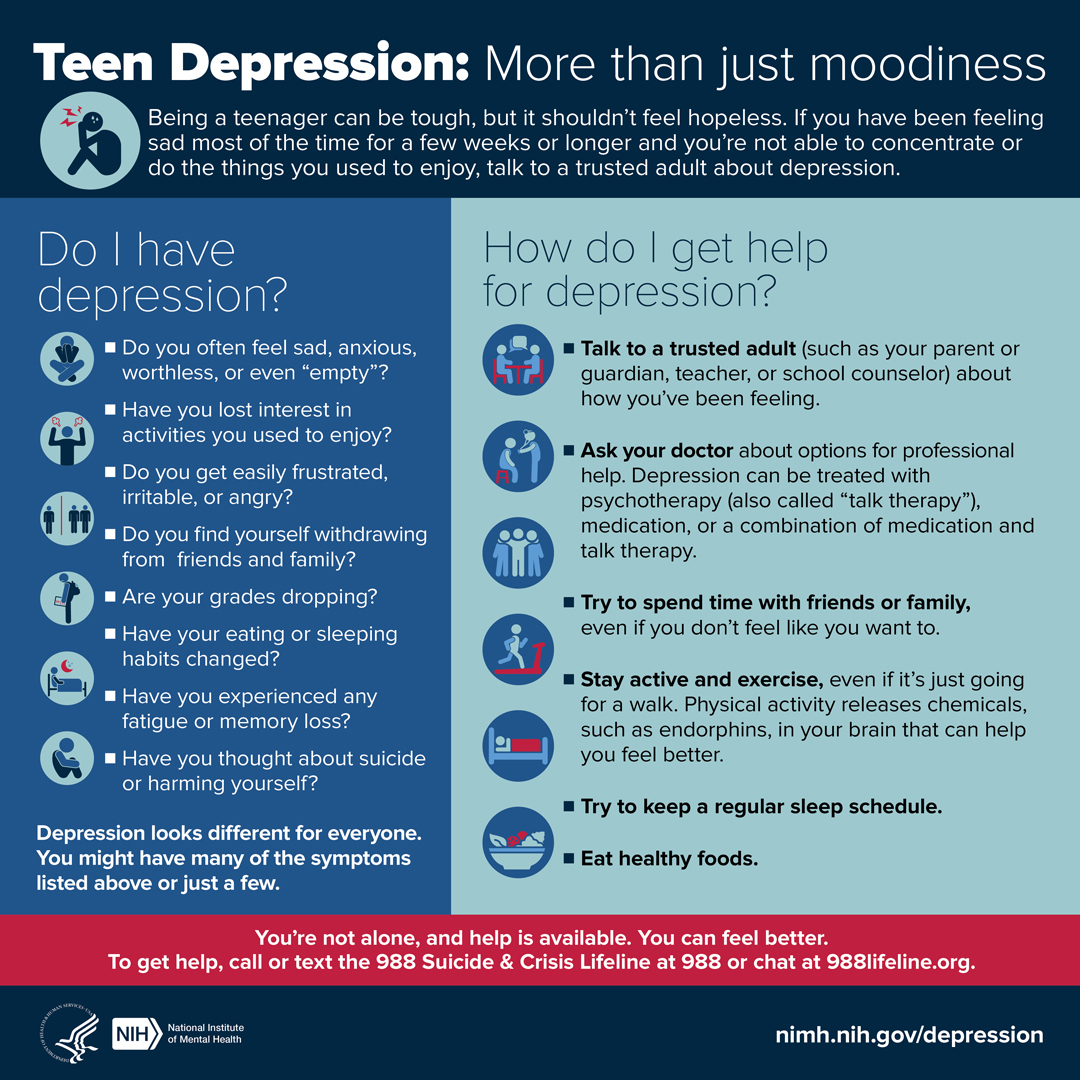
A. Different people experience different symptoms of depression. If you are depressed, you may feel:

You may also experience one or more of the following symptoms:

Depression in adolescence frequently co-occurs with other disorders such as anxiety, disruptive behavior, eating disorders, or substance abuse. It can also lead to increased risk for suicide.

Q. Are there different types of depression?

A. Yes. The most common depressive disorders are:

Other types of depression include:

Q. What causes depression?

A. Depression does not have a single cause. Several factors can lead to depression. Some people carry genes that increase their risk of depression. But not all people with depression have these genes, and not all people with these genes have depression. Environment—your surroundings and life experiences—also affects your risk for depression. Any stressful situation may trigger depression. And high school students encounter a number of stressful situations!

Q. How can I find out if I have depression?

A. The first step is to talk with your parents or a trusted adult who can help you make an appointment to speak with a doctor or mental health care provider. Your family doctor or school counselor may also be able to help you find appropriate care.

The doctor or mental health care provider can do an exam to help determine if you have depression or if you have another health or mental health problem. Some medical conditions or medications can produce symptoms similar to depression. The doctor or mental health care provider will ask you about:

Q. How is depression treated?

A. A number of very effective treatments for depression are available. The most common treatments are antidepressants and psychotherapy. An NIMH–funded clinical trial of 439 teens with major depression found that a combination of medication and psychotherapy was the most effective treatment option.1 A doctor or mental health care provider can help you find the treatment that’s right for you.

Q. What are antidepressants?

A. Antidepressants work on brain chemicals called neurotransmitters, especially serotonin and norepinephrine. Other antidepressants work on the neurotransmitter dopamine. Scientists have found that these particular chemicals are involved in regulating mood, but they are unsure of the exact ways that they work.

Q. If a doctor prescribes an antidepressant, how long will I have to take it?

A. You will need to take regular doses of antidepressants for 4 to 6 weeks before you feel the full effect of these medicines. Some people need to take antidepressants for a short time. If your depression is long lasting or comes back again and again, you may need to take antidepressants longer.

Q. What is psychotherapy?

A. Psychotherapy involves talking with a mental health care professional to treat a mental illness. Types of psychotherapy that have been shown to be effective in treating depression include:

Depending on the type and severity of your depression, a mental health professional may recommend short-term therapy, lasting 10 to 20 weeks, or longer-term therapy.

Q. How can I help myself if I am depressed?

A. If you have depression, you may feel exhausted, helpless, and hopeless. But it is important to realize that these feelings are part of the depression and do not reflect your real circumstances. Treatment can help you feel better.

To help yourself feel better:

Q. How can I help a friend who is depressed?

A. If you think a friend may have depression, you can help him or her get diagnosed and treated. Make sure he or she talks to an adult and gets evaluated by a doctor or mental health provider. If your friend seems unable or unwilling to seek help, offer to go with him or her and tell your friend that his or her health and safety is important to you.

Encourage your friend to stay in treatment or seek a different treatment if he or she does not begin to feel better after 6 to 8 weeks.

You can also:

Q. What if I or someone I know is in crisis?

A. If you are thinking about harming yourself or having thoughts of suicide, or if you know someone who is, seek help right away.

Q. What efforts are underway to help high school students who have depression?

A. Researchers continue to study new ways to diagnose and treat depression in high school age students. Some scientists are also looking into different ways to classify symptoms, which may provide news clues about how the disorder develops and which treatments are most effective. Increasing the early detection and treatment of depression can help more students succeed academically and achieve their goals in school and after graduation.

You can find more information about the causes, diagnosis, and treatment of depression, including research related to adolescents and young adults, on the National Institute of Mental Health (NIMH) website.

You can also connect with NIMH through social media:

Reference

1. March J, Silva S, Petrycki S, Curry J, Wells K, Fairbank J, Burns B, Domino M, McNulty S, Vitiello B, Severe J. Treatment for Adolescents with Depression Study (TADS) team. Fluoxetine, cognitive-behavioral therapy, and their combination for adolescents with depression: Treatment for Adolescents with Depression Study (TADS) randomized controlled trial. Journal of the American Medical Association, 2004; 292(7): 807–820.

Reprints

This publication is in the public domain and may be reproduced or copied without permission from NIMH. We encourage you to reproduce it and use it in your efforts to improve public health. Citation of the National Institute of Mental Health as a source is appreciated. However, using government materials inappropriately can raise legal or ethical concerns, so we ask you to use these guidelines:

If you have questions regarding these guidelines and use of NIMH publications, please contact the NIMH Information Resource Center at 1-866-615-6464 or e-mail at nimhinfo@nih.gov.

For more information on depression
Visit the National Library of Medicine’s MedlinePlus http://medlineplus.govExternal Link: Please review our disclaimer.
En Español http://medlineplus.gov/spanishExternal Link: Please review our disclaimer.

For information on clinical trials
http://www.nimh.nih.gov/health/trials/index.shtml

National Library of Medicine clinical trials database
http://www.clinicaltrials.govExternal Link: Please review our disclaimer.

Information from NIMH is available in multiple formats. You can browse online, download documents in PDF, and order materials through the mail. Check the NIMH website for the latest information on this topic and to order publications. If you do not have Internet access, please contact the NIMH Information Resource Center at the numbers listed below.

National Institute of Mental Health
Office of Science Policy, Planning and Communications
Science Writing, Press and Dissemination Branch
6001 Executive Boulevard
Room 6200, MSC 9663
Bethesda, MD 20892-9663
Phone: 301-443-4513 or 1-866-615-NIMH (6464) toll-free
TTY: 301-443-8431 or 1-866-415-8051 toll-free
FAX: 301-443-4279
E-mail: nimhinfo@nih.gov
Website: http://www.nimh.nih.gov

U.S. DEPARTMENT OF HEALTH AND HUMAN SERVICES
National Institutes of Health
National Institute of Mental Health
Revised 2012
NIH...Turning Discovery Into Health©

Related Information