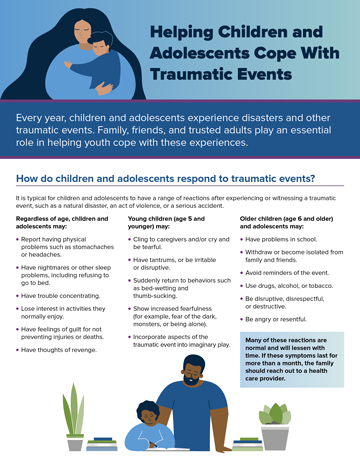
Helping Children and Adolescents Cope with Violence and Disasters: What Rescue Workers Can Do
Introduction
Police, Fire, and other First Responders
Each year, children experience violence and disaster and face other traumas. Young people are injured, they see others harmed by violence, they suffer sexual abuse, and they lose loved ones or witness other tragic and shocking events. Rescue workers including police, fire, and other first responders can help children overcome these experiences and start the process of recovery.
What is Trauma?
“Trauma” is often thought of as physical injuries. Psychological trauma is an emotionally painful, shocking, stressful, and sometimes life-threatening experience (including witnessing events) that may involve physical injuries but also can happen without physical injury. Examples of trauma include a natural disaster, physical or sexual abuse, and terrorism.
Disasters such as hurricanes, earthquakes, and floods can claim lives, destroy homes or whole communities, and cause serious physical and psychological injuries. Trauma can also be caused by acts of violence. The September 11, 2001 terrorist attack is one example. Mass shootings in schools or communities and physical or sexual assault are other examples. Traumatic events threaten people’s sense of safety.
Reactions (responses) to trauma can be immediate or delayed. Reactions to trauma differ in severity and cover a wide range of behaviors and responses. Children with existing mental health problems, past trauma experiences, and/or limited family and social supports may be more reactive to trauma. Frequently experienced responses among children after trauma are loss of trust and a fear of the event happening again.
It’s important to remember:
- Children’s reactions to trauma are strongly influenced by adults’ responses to trauma.
- People from different cultures may have their own ways of reacting to trauma.
Helping Young Trauma Survivors
Helping children begins at the scene of the event. It may need to continue for weeks or months. Most children recover within a few weeks. Some need help longer. Grief (a deep emotional response to loss) may take months to resolve. It could be for a loved one or a teacher. It could be for a friend or pet. Grief may be re-experienced or worsened by news reports or the event’s anniversary.
Some children may need help from a mental health professional. Some people may seek alternative kinds of help. They may turn to religious or community leaders.
Identify children who need the most support. Help them obtain it. Monitor their healing.
Identify Children Who:
- Refuse to go places that remind them of the event
- Seem numb emotionally
- Show little reaction to the event
- Behave dangerously
These children may need extra help.
In general adult helpers should:
- Attend to children
- Listen to them
- Accept/do not argue about their feelings
- Help them cope with the reality of their experiences
- Reduce effects of other sources of stress including:
- Frequent moving or changes in place of residence
- Long periods of time away from family and friends
- Pressures at school
- Transportation problems
- Fighting within the family
- Being hungry
- Monitor healing
- It takes time
- Do not ignore severe reactions
- Attend to sudden changes in behaviors, speech, language use, or in emotional/feeling states
- Remind children that adults
- Love them
- Support them
- Will be with them when possible
What can rescue workers do to help?
After violence or disaster rescue workers should protect children from:
- Further harm
- Traumatic sights and sounds
- Onlookers and media.
Rescue workers should also be kind, but firm in directing children away from the event site and injured survivors. They should try to keep children together with family and friends.
Rescue workers can help identify children in acute distress and stay with them until they are calm. Signs of acute distress include:
- Trembling
- Rambling
- Becoming mute
- Exhibiting erratic behavior such as loud crying, rage, or sitting completely still or frozen.
Rescue workers should be tolerant of difficult behavior and strong emotions. Supportive acts that help children feel safe are a quick hug or a reassuring word.
Help for all People in the First Days and Weeks
Key steps can help adults cope so they can provide better care for children. The first steps include creating safe conditions, remaining calm and friendly, and connecting to others. It is also important to be sensitive to difficult people and encourage respect for adult decision-making.
Do:
- Get food
- Get a safe place to live
- Get help from a doctor or nurse if hurt
- Contact loved ones or friends
- Keep children with parents or relatives
- Understand what happened
- Understand what is being done
- Know where to get help
- Meet your own family’s needs.
Don’t:
- Force people to tell their stories
- Probe for personal details
- Say things like “everything will be OK,” or “at least you survived”
- Say what you think people should feel or how people should have acted
- Say people suffered because they deserved it
- Be negative about available help
- Make promises that you can’t keep such as “you will go home soon.”
How Children React to Trauma
Children’s reactions to trauma can be immediate. Reactions may also appear much later. Reactions differ in severity. They also cover a range of behaviors. People from different cultures may have their own ways of reacting. Other reactions vary according to age.
One common response is loss of trust. Another is fear of the event reoccurring. Some children are more vulnerable to traumas. Children with mental health problems may be more affected. Children with experience of other traumas may be more affected.
Children Age 5 and Under
Children under five can react in a number of ways:
- Facial expressions of fear
- Clinging to parent or caregiver
- Crying or screaming
- Whimpering or trembling
- Moving aimlessly
- Becoming immobile
- Returning to behaviors common to being younger
- Thumb sucking
- Bedwetting
- Being afraid of the dark
Young children’s reactions are strongly influenced by parent reactions to the event.
Children Age 6 to 11
Children in this range may:
- Isolate themselves
- Become quiet around friends, family, and teachers
- Have nightmares or other sleep problems
- Become irritable or disruptive
- Have outbursts of anger
- Start fights
- Be unable to concentrate
- Refuse to go to school
- Complain of physical problems
- Develop unfounded fears
- Become depressed
- Become filled with guilt
- Feel numb emotionally
- Do poorly with school and homework
Adolescents Age 12 to 17
Children in this range have various reactions:
- Flashbacks to the event (flashbacks are the mind reliving the event)
- Avoiding reminders of the event
- Drug, alcohol, tobacco use and abuse
- Antisocial behavior i.e. disruptive, disrespectful, or destructive behavior
- Physical complaints
- Nightmares or other sleep problems
- Isolation or confusion
- Depression
- Suicidal thoughts
Adolescents may feel guilty. They may feel guilt for not preventing injury or deaths. They also may have thoughts of revenge.
More About Trauma and Stress
Some children will have prolonged problems after a traumatic event. These may include grief, depression, anxiety, and post-traumatic stress disorder (PTSD). Some trauma survivors get better with some support. Others may need prolonged care by a mental health professional. If, after a month in a safe environment children are not able to perform their normal routines or new behavioral and emotional problems develop, then consider contacting a health professional.
Factors influencing how one may respond include:
- Being directly involved in the trauma, especially as a victim
- Severe and/or prolonged exposure to the event
- Personal history of prior trauma
- Family or personal history of mental illness and severe behavioral problems
- Limited social support; lack of caring family and friends
- On-going life stressors such as moving to a new home, or new school, divorce, job change, and financial troubles.
Some symptoms may require immediate attention. Contact a mental health professional if these symptoms occur:
- Flashbacks
- Racing heart and sweating
- Being easily startled
- Being emotionally numb
- Being very sad or depressed
- Thoughts or actions to end life.
It is also important to recognize in the confusion or chaos after a crisis event children and adults can be particularly vulnerable to predators. Adults caring for children must be mindful of the limitations of environments that are created for shelter or other services.
For More Information
Visit the National Library of Medicine’s
MedlinePlus http://medlineplus.gov
En Español http://medlineplus.gov/spanish
For information on clinical trials
http://www.nimh.nih.gov/health/trials/index.shtml
National Library of Medicine clinical trials database
http://www.clinicaltrials.gov
Information from NIMH is available in multiple formats. You can browse online, download documents in PDF, view videos, and order materials through the mail. Check the NIMH website at http://www.nimh.nih.gov for the latest information on this topic and to order publications. If you do not have Internet access, please contact the NIMH Information Resource Center at the numbers listed below.
National Institute of Mental Health
Office of Science Policy, Planning and Communications
Science Writing, Press and Dissemination Branch
6001 Executive Boulevard
Room 6200, MSC 9663
Bethesda, MD 20892-9663
Phone: 301-443-4513 or 1-866-615-NIMH (6464) toll-free
TTY: 301-443-8431 or 866-415-8051 toll-free
FAX: 301-443-4279
E-mail: nimhinfo@nih.gov
Website: http://www.nimh.nih.gov
Reprints
This publication is in the public domain and may be reproduced or copied without permission from NIMH. We encourage you to reproduce it and use it in your efforts to improve public health. Citation of the National Institute of Mental Health as a source is appreciated. However, using government materials inappropriately can raise legal or ethical concerns, so we ask you to use these guidelines:
- NIMH does not endorse or recommend any commercial products, processes, or services, and our publications may not be used for advertising or endorsement purposes.
- NIMH does not provide specific medical advice or treatment recommendations or referrals; our materials may not be used in a manner that has the appearance of such information.
- NIMH requests that non-Federal organizations not alter our publications in ways that will jeopardize the integrity and “brand” when using the publication.
- Addition of non-Federal Government logos and website links may not have the appearance of NIMH endorsement of any specific commercial products or services or medical treatments or services.
- If you have questions regarding these guidelines and use of NIMH publications, please contact the NIMH Information Resource Center at 1-866-615-6464 or e-mail at nimhinfo@nih.gov.
U.S. Department of Health and Human Services
National Institutes of Health
National Institute of Mental Health
NIH Publication No. 12–3520
Revised 2012
NIH...Turning Discovery Into Health