




Staff Bios
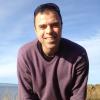
Peter A. Bandettini
Chief of Section on Functional Imaging Methods
Email: bandettini@nih.gov
Phone: (301) 402-1333
Dr. Bandettini received his B.S. in Physics from Marquette University in 1989 and his Ph.D. in Biophysics from the Medical College of Wisconsin in 1994, where he and his fellow graduate student, Eric Wong, played a role in the early development of magnetic resonance imaging of human brain function using blood oxygenation contrast. During his postdoctoral fellowship at the Massachusetts General Hospital, he continued his investigation of methods to increase the interpretability, resolution, and applicability of functional MRI techniques. In March of 1999, he joined NIMH as an Investigator in the Laboratory of Brain and Cognition and as the Director of the NIH Functional MRI core facility. In 2001, he was awarded the Scientific Director's Merit Award for his efforts in establishing the NIH FMRI core facility and in 2007 the team that he created was also awarded the Scientific Director's Merit Award for their outstanding work. In 2002, he was awarded the Wiley Young Investigator's Award at the annual Organization for Human Brain Mapping Meeting.
Dr. Bandettini is currently Editor-In-Chief of the journal NeuroImage. He has been deeply involved with the Organization for Human Brain Mapping (OHBM) since 1997, serving as President from 2005-2007, Chair of the Program Committee from 2011-present and from 2001-2003, Secretary from 1999-2001, Chair of the Education Committee from 2000-2001. He has been a member of the OHBM scientific program committee for all years since 1997 except 1998, and 2008-11. He has also been very active in the International Society for Magnetic Resonance in Medicine (ISMRM), serving on their program committee from 2007-2010.
His laboratory is currently developing MRI methods improve resolution, sensitivity, interpretability, and applicability of functional MRI. His specific scientific interests are in the areas of fMRI decoding, multiple simultaneously embedded contrast fMRI, resting state fMRI, and multi-modal imaging. He also is very much motivated to move fMRI from a niche technique for understanding brain function in mostly healthy individuals and groups to a robust and informative technique that is used in the clinic on individuals to help diagnose disease and help predict treatment outcome. He strongly feels fMRI has considerable untapped potential for revealing a wealth of neuronal and physiologic information from individuals.
Google Scholar: https://scholar.google.com/citations?user=X9OdRnYAAAAJ&hl=en
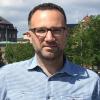
In 2001, Dr. Gonzalez-Castillo received a B.S. and M.S in Electrical and Computer Engineering (Ingenieria de Telecomunicaciones) from Universidad Politecnica de Madrid, Spain. Following graduation, he spent one year as a research assistant in HP-Labs, Bristol (UK) working on electronic-commerce automation technologies; followed by three more years as an IT consultant for Hewlett-Packard Spain. Those years in IT industry helped Dr. Gonzalez-Castillo develop key skills in the areas of computer science, data analytics, and project management. In the early 2000s, Dr. Gonzalez-Castillo decided to change professional tracks and find ways to apply his engineering skills to solving biological problems. In 2004, he was awarded a Fulbright Fellowship to pursue a Ph.D. in Biomedical Engineering at Purdue University, West Lafayette, IN. During his time at Purdue, he worked on several language-related fMRI studies under the mentorship of Prof. Thomas Talavage and was awarded a Bilsland Dissertation Fellowship for his dissertation research. In December 2009, Dr. Gonzalez-Castillo graduated from Purdue and joined the Section on Functional Imaging Methods (SFIM) at the National Institute of Mental Health (NIMH) in Bethesda, MD as a post-doctoral fellow. In 2014, Dr. Gonzalez-Castillo was promoted to Staff Scientist within the Section. His research at the SFIM focuses on three main topics: development of novel fMRI analytical methods that help increase fMRI’s ability to precisely answer both clinical and basic neuroscientific questions; understanding the most dynamical aspects of functional connectivity (e.g., fast reconfigurations that happen within the constraints of individual scans), and modeling sources of non-clinical day-to-day and subject-to-subject variability in fMRI so that clinically relevant information present in fMRI scans can be isolated and more easily interpreted.
Google Scholar: https://scholar.google.com/citations?user=CGQ3Lw4AAAAJ&hl=en
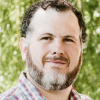
Daniel Handwerker received a BS in Biomedical Engineering and a BA in Computer Science from Johns Hopkins University where he first started working with fMRI in neuroscience and psychology labs. He received his PhD from the University of California at Berkeley and San Francisco Joint Graduate Group in Bioengineering where he worked with Marc D’Esposito to examine the range of observable hemodynamic response variation in fMRI as well as finding ways to account for this variation during data acquisition and analysis. After a postdoctoral fellowhip at UCSF with Roland Henry to use fMRI and DTI, Dr. Handwerker joined Peter Bandettini’s Section on Functional Imaging Methods at NIMH initially as a postdoctoral fellow and now as a staff scientist. In addition to using his neuroscience, fMRI acquisition, and data analysis expertise to support many researchers in SFIM, his research focuses on finding ways to improve the quality of fMRI data through better acquisition, preprocessing, and analysis methods. This has included work on functional connectivity dynamics, identifying and removing noise based on vascular variation, and noise removal methods that take advantage of multi-echo fMRI information. He is currently one of the main developers of tedana.readthedocs.io, which is software to remove noise from multi-echo fMRI data.
Google Scholar: https://scholar.google.com/citations?user=rMRpQqUAAAAJ&hl=en&oi=sra
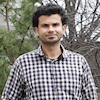
Burak graduated from Bilkent University with a B.Sc. in Electronics. Shortly after his graduation he joined to Turkey’s first national MR research center (UMRAM), where he started working with fMRI in various clinical and cognitive studies. After completing his master’s in biomedical engineering with bioelectricity & biomagnetism track, he started his PhD in University Medical Center Freiburg, where he worked with Dr. Pierre LeVan and Prof. Jürgen Hennig to understand dynamic interactions of brain networks by using fast fMRI. He is interested in multimodal brain imaging, fMRI acquisitions, processing pipelines and data visualization. He joined NIMH as a postdoctoral fellow in January 2021. He will be working on spatio-temporal characteristics of laminar fMRI and development of novel processing methods.
Google Scholar: https://scholar.google.com/citations?hl=en&user=GDsYRDgAAAAJ
Sharif I. Kronemer, PhD earned a BA in Neuroscience and Philosophy from Ohio Wesleyan University (2012), followed by an MSc in Cognitive Neuroscience from University College London (2013). He completed his PhD at Yale University in 2021 where his research combined fMRI, scalp and intracranial EEG, pupillometry, and machine learning to explore the human brain mechanisms of visual consciousness. Currently, Dr. Kronemer is a Postdoctoral Fellow in the Section on Functional Imaging Methods at the National Institute of Mental Health. His research focuses on uncovering the brain mechanisms that distinguish real versus illusory visual perception and studying spontaneous fluctuations in conscious state using advanced neuroimaging techniques, including high-field fMRI and MEG. Dr. Kronemer is also leveraging machine learning and non-neural physiological signals to predict conscious perception in healthy individuals and patient groups (e.g., cortical blindness). Beyond the lab, Dr. Kronemer is a dedicated science communicator and advocate for public engagement in science.
Google Scholar: https://scholar.google.com/citations?hl=en&user=byaXSFsAAAAJ
Josh is a postdoctoral fellow in the Section on Functional Imaging Methods at the National Institute of Mental Health. His work focuses on understanding the brain as an interconnected, complex system. He received his Ph.D. in 2021 under the mentorship of Dr. Olaf Sporns, with funding support from the NSF GRFP program and the IU Graduate School. His doctoral work focused on examining brain architecture through the lens of network science and its applications, including community detection and edge-centric modeling. Josh graduated from the University of Southern California with a degree in neuroscience and cognitive science. When not thinking about brains, Josh prefers to spend his time consuming fine coffees & cheeses, prog rock, and televised sporting competitions of all kinds.
Google Scholar: https://scholar.google.com/citations?hl=en&user=GE4rM3QAAAAJ
Catherine Walsh recieved a B.A. in Behavioral Neuroscience from Colgate University, where she used EEG to study early visual processing. Before attending graduate school, Catherine worked as a post-baccalaureate fellow with Dr. Alex Martin in the Lab of Brain and Cognition, where she had her first experiences working with fMRI. Catherine receieved her Ph.D in 2023 from the University of California, Los Angeles where she worked with Dr. Jesse Rissman to study individual differences in memory using behavioral and neuroimaging methods. After her Ph.D., Catherine joined Peter Bandettini’s Section on Functional Imaging Methods at the NIMH as a Scientific Programmer. In this role, Catherine supports ongoing work in the lab by aiding with scientific programming, sharing of data and general IT support. Additionally, Catherine’s own research seeks to apply the novel data acquisition and analysis methods developed in SFIM to the cognitive neuroscience of memory.
Google Scholar: https://scholar.google.com/citations?user=yVGwb1QAAAAJ&hl=en&oi=ao

Cassie is a post-bac in Alex Martin’s Section on Cognitive Neuropsychology who is collaborating with Sharif Kronemer in SFIM to study visual perception and reality monitoring with fMRI and MEG. She graduated from the University of Wisconsin – Madison with a B.S. in neurobiology. After her post-bac, Cassie plans on getting her PhD in cognitive neuroscience and is interested in studying disorders of consciousness and sensory-independent visual perception.
Esther received her B.A. in Psychology from Emory University in May 2023. As an undergraduate, she worked with Dr. Jennifer Stevens at the Grady Trauma Project, investigating neuroendocrine risk factors for PTSD in women using fMRI. After graduation, she joined the National Institute on Alcohol Abuse and Alcoholism (NIAAA) under Dr. Nora Volkow, where she applied PET and fMRI techniques to study dopaminergic signaling in individuals recovering from opioid use disorder. Her clinical research exposure deepened her appreciation for the role of functional imaging in understanding human disease and sparked a growing interest to explore its technical and methodological foundations. Pursuing this interest, she joined Dr. Peter Bandettini’s core (FMRIF) and section (SFIM), where she contributes to a deep sampling study focused on capturing stable and dynamic aspects of brain function. She plans to pursue an MD or MD-PhD to integrate clinical care with innovative imaging science.

Marly Rubin graduated from American University in December 2023 with a major in neuroscience. As an undergraduate, she worked with Dr. Catherine Stoodley to investigate the role of the cerebellum in autism spectrum disorder. Her final project examined how cerebellar circuits contribute to functional connectivity alterations in ASD. She joined SFIM as a postbac IRTA in spring 2024 to further explore neuroimaging methods. Following her fellowship at the NIH, she plans to pursue a PhD in neuroscience.
Marlene Smith graduated from the University of California, Los Angeles with a B.S. in mathematics. She joined SFIM as a postbac IRTA in the summer of 2025. While at SFIM, Marlene hopes to apply her theoretical and computational skills to understand and improve neuroimaging methods. After her postbac, she plans to pursue her PhD.

Plyfaa Suwanamalik-Murphy graduated from the University of California, Davis, in the Spring of 2024, majoring in Cognitive Science. She has previously investigated the perception of iridescence, search performance within naturalistic scenes using eye-tracking, and how the C1 component reflects the initial feedforward signal in V1. Joining SFIM as a postbac IRTA in the Summer of 2024, Plyfaa aims to further build on her computational skills within research and explore neuroimaging methods. Upon completion of her fellowship at the NIH, she intends to pursue a Ph.D. in cognitive neuroscience.

Stephanie Swegle graduated from the University of Notre Dame in May 2024 with a major in Neuroscience and Behavior and a minor in Data Science. During undergrad, she conducted gut microbiome research in the Archie Lab at Notre Dame, the Sonnenburg Lab at Stanford University and the Gibbons Lab at the Institute for Systems Biology. In these labs, she studied microbial niche space, the host range of bacteriophages, and how diet impacts the abundances of microbes that produce neurotransmitters. Stephanie joined NIH in July 2024 as a postbac IRTA. Specifically, she will work with Renzo Huber in the layer-fMRI group within Peter Bandettini’s section (SFIM) and core (FMIRF). She is excited to learn more about neuroimaging and how to use fMRI to explore the cortical layers of the brain. After her NIH fellowship, Stephanie plans to pursue a PhD in neuroscience, psychology or biology. In the future, she hopes to use neuroimaging methods to study the gut-brain connection.